
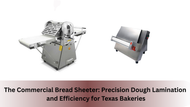
The Commercial Bread Sheeter: Precision Dough Lamination and Efficiency for Texas Bakeries
The Commercial Bread Sheeter: Precision Dough Lamination and Efficiency for Texas Bakeries
In the demanding world of Texas baking—from artisan shops crafting delicate croissants in Austin to high-volume pizzerias feeding the masses in Houston—consistency is the secret ingredient. Manually rolling dough to perfect, uniform thickness is slow, labor-intensive, and prone to error. This is where the commercial bread sheeter becomes an indispensable piece of equipment, transforming a time-consuming manual task into a rapid, precise, and consistent process.
At Texas Restaurant Supply, we know that successful bakeries and high-end restaurants rely on precision to manage costs and maintain product quality, especially when catering to the state's insatiable appetite for baked goods.
The Science of Consistency: Why Lamination Matters
A commercial dough sheeter works by passing a lump of dough through adjustable rollers, gradually compressing it into a thin sheet of exact, repeatable thickness.
H3: Achieving Uniform Thickness for Quality Control
Uniformity is vital for both product quality and portion control. In a busy Dallas bakery producing hundreds of items daily:
-
Quality: Uniform thickness ensures even baking. Think of a puff pastry or a pizza crust; thin spots burn, while thick spots remain raw. The sheeter eliminates this variability.
-
Cost Management: Consistent sheeting ensures consistent portion sizes, minimizing dough waste and maximizing profit per batch—a critical concern for any Texan business monitoring its bottom line.
H3: Mastering Lamination for High-End Pastries
For laminated doughs, such as those used in croissants, danishes, or even the wildly popular Texas-style kolache, the commercial bread sheeter is non-negotiable. Lamination involves folding butter into the dough repeatedly to create hundreds of delicate layers. The sheeter handles this process gently and quickly, preventing the butter from warming up and melting, which would ruin the final texture and flakiness.
Choosing the Right Sheeter for Your Texas Volume
Selecting the appropriate sheeter model is crucial for matching your production needs.
H3: Manual vs. Automatic Models
Sheeters are generally categorized by their operation style:
-
Manual (Tabletop): Best for lower-volume artisan shops or smaller restaurants. The dough is fed and retrieved by hand, but the rollers provide the needed precision. These are often seen in small-town Texas bakeries focused on tradition.
-
Automatic (Floor Models): Designed for continuous, high-volume production, such as commercial wholesale bakeries or large hotel chains in San Antonio. These models can handle heavier doughs and significantly cut down on labor costs.
H3: Safety and Sanitation Standards in Texas
As with all food contact equipment, adherence to sanitation codes is mandatory. Ensure your commercial bread sheeter is easy to clean. Look for:
-
Durable Materials: Stainless steel construction that resists corrosion and is easy to wipe down.
-
Safety Features: Critical safety features include emergency stop buttons, blade guards, and protective mechanisms to ensure operator safety during high-speed rolling—a requirement stressed by Texas health code regulations.
Operational Impact: Speeding Up Production from Houston to El Paso
The primary benefit of integrating a commercial sheeter is speed. What might take a trained baker 30 minutes to roll by hand can be done in a fraction of the time with consistent results. This increased output is essential for scaling up operations to meet large holiday demands or managing multiple restaurant locations across Texas.
Conclusion and Call to Action (CTA)
The commercial bread sheeter is a vital investment that delivers efficiency, reduces labor hours, ensures portion control, and—most importantly—guarantees the consistent, high quality of your baked goods. For Texas businesses where volume meets high expectations, a sheeter provides the competitive edge needed to succeed.